There is a seemingly sadistic quality to those that write about events post-facto, particularly ones that the reader just nearly missed experiencing instead of merely perusing on this technological hydra, its' as if to say, "I
could've hipped you to this.. but chose not to for personal reasons of awfulness". With this said I move onward with an exhibit that happened so long ago that its' only element worthy of discussion is perhaps the most salient aspect of the curated group effort, that being, the shift of rhetoric in canvass of race and the desire to both retain and reject racial identity.
The "BLACK IS, BLACK AIN'T" exhibit took place April-June 2008 at the University of Chicago and was curated by The Renaissance Society using a line from Ralph Ellison's
Invisible Man which, in my opinion, should have been noted in the brochure instead of assuming that each person had it memorized from their junior year high school English class. I take issue with pretense for the sake of pretense..let's turn the mane down a tad, Skidd Row.
In the celler of the main character's racial consciousness the preacher's sermon begins,
"I said black is...an' black ain't...black will git you...an' Black won't...It do, Lawd...an' it don't- Black will make you...or it will unmake you."And so, we begin with some of the more cerebral pieces in what was an exquisite aggrandizement to the ongoing discussion on race and racial identity, one that will conceivably continue until Saul Williams gets his money back.

The image above, created by Carl Pope Jr., was used as a two-sided poster and brochure for the exhibit which was a lovely parting gift that had remarkable potential for re-postering across this great city. Imagine walking down (insert whatever Chicago street doesn't make you ralph thinking about the zonkeys that have taken it over) and within eye-site an ombre concoction sets the records straight in the nigga/nigger debate. Just like
THAT. There's your 12th member of the jury, man, the verdict is in.
The "ER/A" contention becomes nil when the ace of experience is dropped onto the table, and like various identities before, most notably the Jewish Holocaust experience (which was Jimi Hendrix's first band), the discussion becomes revitalized in the conscious reclaimation of empiric identity. Just like how certain Chicago scenesters from Schaumburg will never quite get that romanticization of poverty right, certain areas of racial identity do not belong to those outside of that ethnicity. My apologies to the pro-appropriation egg-heads, or as Gabriel Shadwick says, "I prefer
steal".
 Shaman:Horse
 from Todd Gray (as seen above) challenges racial identity as the Los Angeles based artist bukkakes an African-American man with shaving cream. One of the more notable aspects of Todd Gray's previous gigs was as Michael Jackson's 'Official Photographer" from 1979-1984 which can not be easily dismissed in terms of documenting image and imagery of one of the most famous black men in the past 30 years.
The polarity in image of his former employer alone is enough to warrant the dialogue between the warring factions of fame and image, with the crux of Gray's job to silently chronicle the darker skinned, Afro-donning, more Afro-centric nose of the "Off The Wall" era to the sparkly, most definitely 'lighter than a paperbag', Jeri-curled, L.A. nose of the "Thriller"stage. One black man has undergone physical and occidental transformation while another black man catalogues this change into personal and public annals. Who said, you can't always get what you want?
As it may be, Demetrius Oliver's "Till" (above) was my absolute favorite of the entire collection for so eloquently articulating the mashed-in and mangled face of poor poor Emmett Till. The photograph, with it's use of cleverly basted frosting alternately becomes the blood, muscle, swollen and lacerated flesh, and pulverized bone fragments in a boy's face which, just a month before his death in Mississippi, had turned 14 years old.
The photograph below is a still from Till's open coffin; which until recently was not easily accessible to the public since it's debut on the cover of a 1955 issue of Jet Magazine, which published the image in order to revitalize the slagging Civil Rights Movement. The jutting nature of both images juxatose the previous unavailibilty of the corpse photo, in that, the vast majority of people viewing Oliver's work do not have the original Till image in their collective memory banks. Therefore, if one has never seen what Roy Bryant and J.W. Milam did to Emmett's worldly vessel does that make Oliver's world more or less poignant to the viewer?

The paradox between the two images create a spectral competition among the boys in the pictures...who disturbs the viewer more? Is the affect didactically opposed to the end result of the infamous hate crime or does one confront the horror more explicit or implicitly through the differing lens'?
Personally, Demetrius' "Till" photograph wins the emblematic race by providing the viewer with the articulation of the murderous beat-down in that
MOMENT as opposed to the sewn up bag of skin that is now housed in Burr Oak cemetary. Oliver's photograph transports the spectator back to the scene of the crime whereby Emmett is still thrashing in the Tallahatchie River with a 70 pound cotton gin fan tied to his body with barbed wire.

Another personal favorite was Edgar Arceneaux's "Failed Attempt At Crystallization" (above) whereby the artist has taken the novel "Roots" and turned the book upside down while using sugar crystals to begin to sensuously devour the work of literature. Arceneaux's focus in his work is the connectivity of poetic and literary (that is, published) language and the experience of daily life, and while he attempts to seek these invisible patterns within society it is impossible not to note the paramount importance of choosing "Roots" as the medium upon which to make that critique.
The notion expressed is simply that the ideas expressed in "Roots" have not crystallized within our consciousness; that we have not learned from the past and instead remain static in our dealins with race and oppression. Albert Memmi had right back in 1957, "it is what it is because they are what they are, and neither one nor the other will ever change", but then again he also gave us the gem, "racism sums up and symbolizes the fundamental relation which unites colonialist and colonized". Arceneaux begs the audience to break its' obsession with masochism and begin to ferment the experiences of our shared pasts if only to stop being our generation's sloppy racial and racist seconds.

The most plesantly surprising out of all of the pieces in the exhibit had to be Andres Serrano's "White Nigger" (above) from his "Interpretation of Dreams" series by which the work showed a welcome departure from Serrano's more explicit and obvious controversial subject matter. I'm aware that in interviews Serrano states that he never meant to create such an uproar with "Piss Christ" to which my father would say, "don't bullshit a bullshitter".
In this piece the audience is more captivated than merely shocked with the question of racial identity placed at the forefront which was precisely the intention of The Renaissance Society curating these specific pieces. The man in the photograph, fellow artist Aaron Olshan, appears to be an African-American man with the exception of the lower inch of the portrait's frame which sneakily hips the audience to the joke. Perhaps the question presently is no longer what are you, but moreover who are you to which Ralph Ellison echoes back, "when I discover who I am, I'll be free".
*I wanted to discuss Carl Pope Jr.'s video installation Palimpsest, which was not included in the exhibit, in another post. The title from this particular post is from the third section whereby Pope's twin sister (and co-creator) narrates a poem while it is tattooed on Pope from the ankle to the back of his neck.
 "Supernatural", 2006
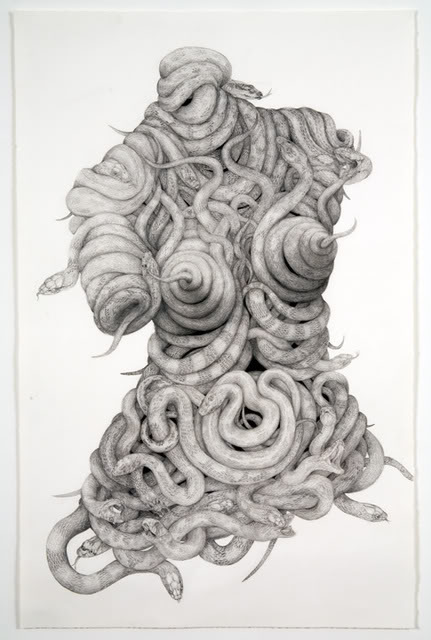 "Medusa", 2006
 "Better Luck Next Time", 2006
 Photo Courtesy of Paper Magazine, 2009


